The Answer Gap · United States and Canada

What AI assistants can tell people about the United States and Canada depends on which websites give them access

The Answer Gap measures what 55,868 United States websites with a clear result tell AI crawlers, and compares the results with Canada and the world.

ImagesPress releaseCheck a website

Article 19 of the Universal Declaration of Human Rights states that everyone has the right to seek, receive and impart information and ideas through any media and regardless of frontiers.Universal Declaration of Human Rights, 1948

When trusted organisations block AI assistants from accessing their websites, people may face life-changing decisions without the full, reliable information those organisations publish and the public deserves.

When you ask AI a question, whose information reaches you, whose voice is missing, and how does that shape what you do next?

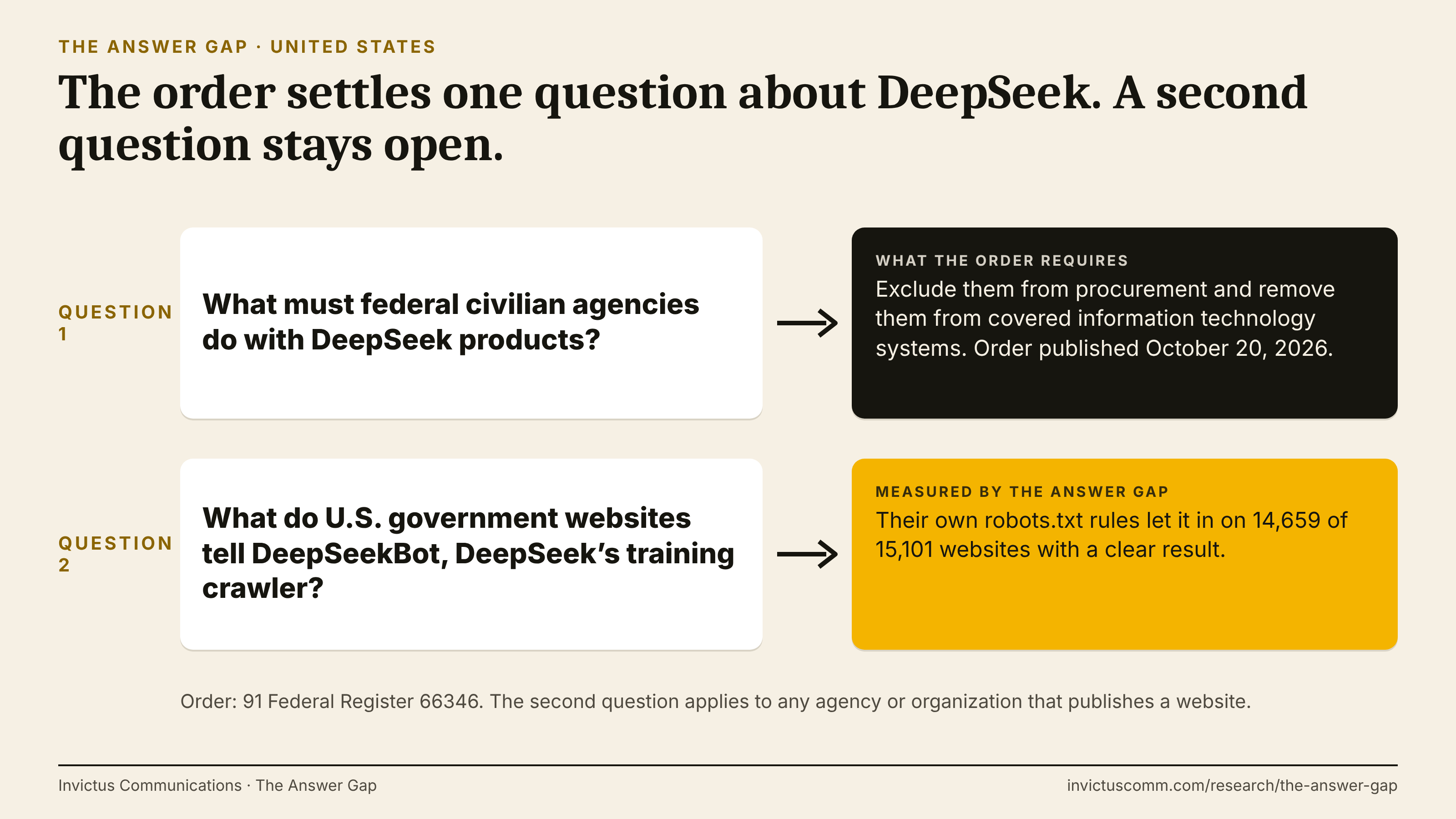
97.1%of 15,101 U.S. government websites with a clear result let in DeepSeekBot, the training crawler of DeepSeek (14,659 websites)
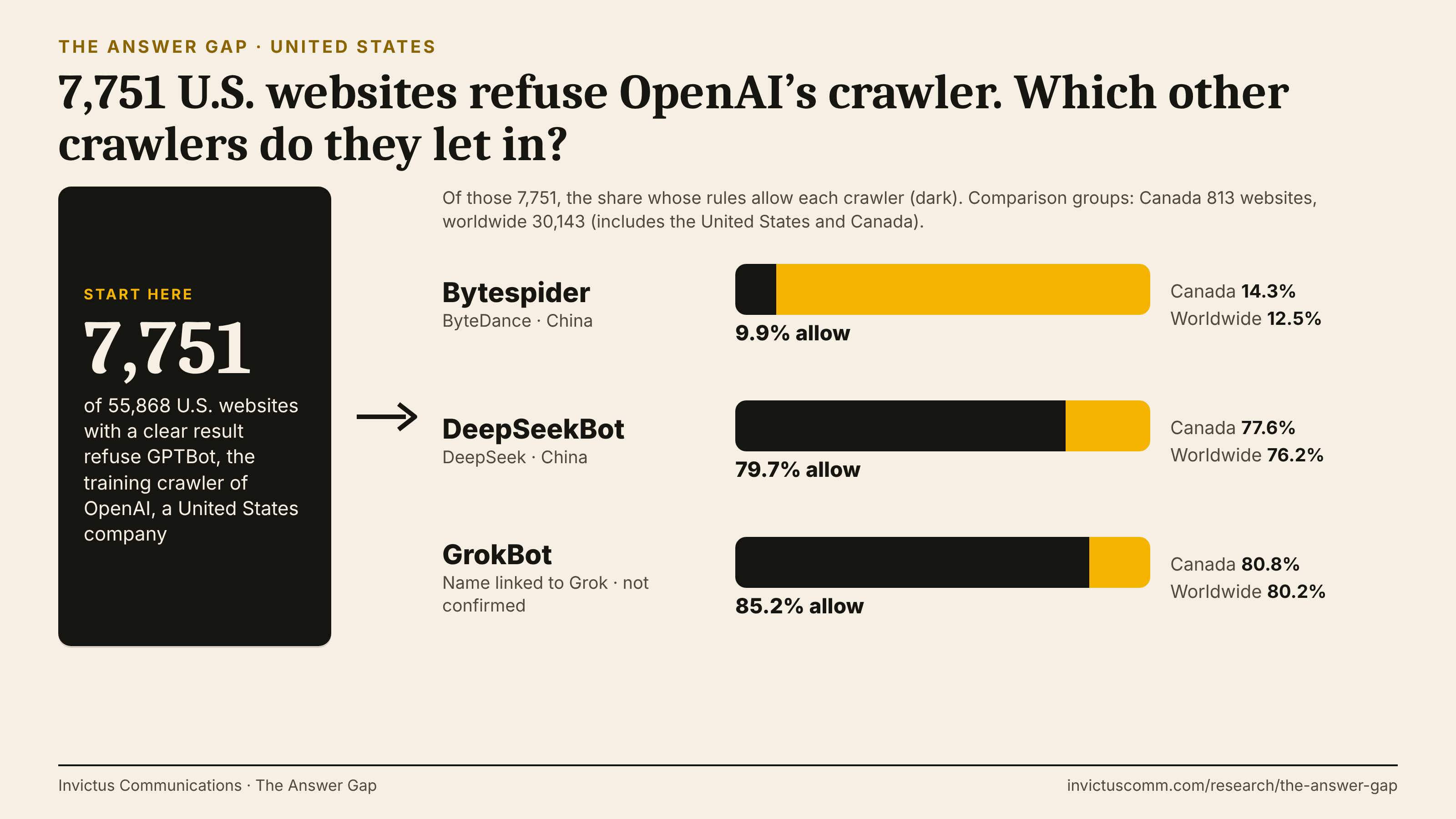
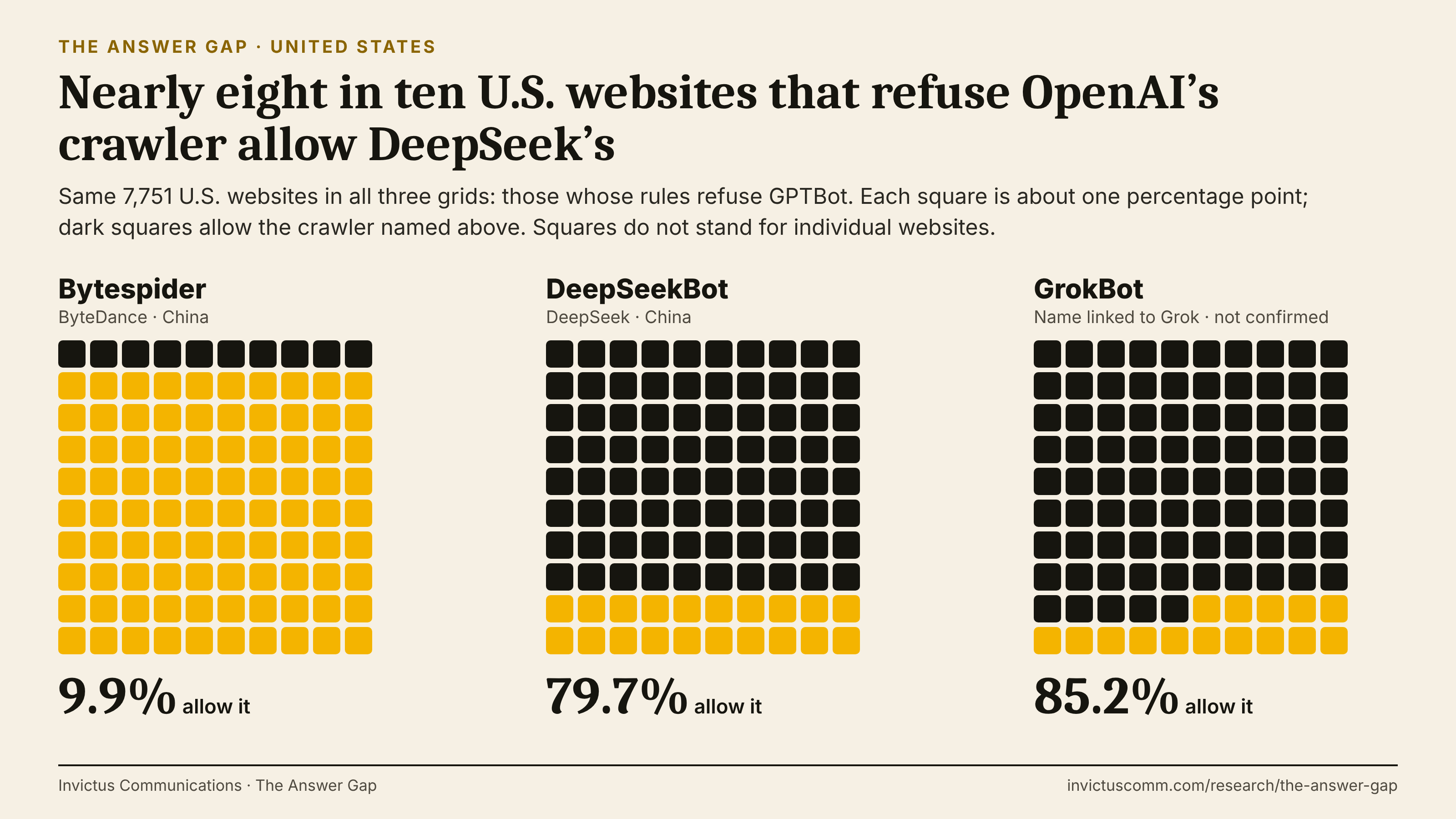
79.7%of the 7,751 U.S. websites that refuse OpenAI’s GPTBot allow DeepSeekBot. Canada: 77.6%. Worldwide: 76.2%
9.9%of those 7,751 allow ByteDance’s Bytespider. Canada: 14.3%. Worldwide: 12.5%

Press release

Journalists, researchers and regulators can request the full report free of charge: lindsay@invictuscomm.com. The summary and data tables are at invictuscomm.com/research/the-answer-gap/.

Images for publication

Free to publish with credit to Invictus Communications.
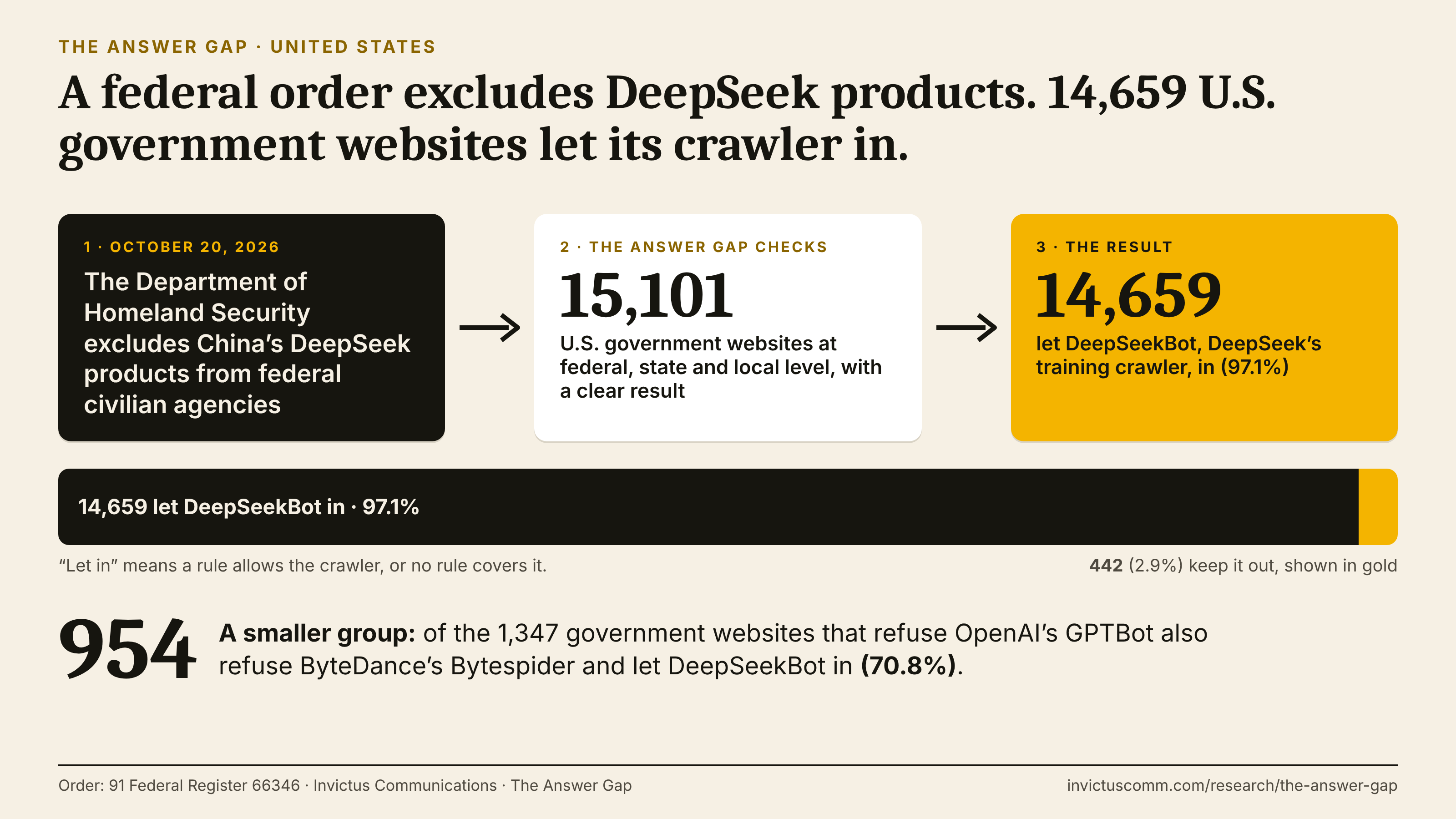
Infographic: on October 20, 2026 the Department of Homeland Security excluded China’s DeepSeek products from federal civilian agencies. Of 15,101 U.S. government websites at federal, state and local level with a clear result, 14,659 (97.1%) let DeepSeekBot, DeepSeek’s training crawler, in; 442 keep it out. Of the 1,347 that refuse OpenAI’s GPTBot, 954 (70.8%) also refuse ByteDance’s Bytespider and let DeepSeekBot in.
A federal order and U.S. government websitesDownload image (PNG, 3200 × 1800)
Infographic: 7,751 of 55,868 U.S. websites with a clear result refuse GPTBot. Of those, 9.9% allow Bytespider (ByteDance, China), 79.7% allow DeepSeekBot (DeepSeek, China) and 85.2% allow GrokBot. Canada: 14.3%, 77.6%, 80.8%. Worldwide: 12.5%, 76.2%, 80.2%.
Which other crawlers do websites that refuse OpenAI let in?Download image (PNG, 3200 × 1800)
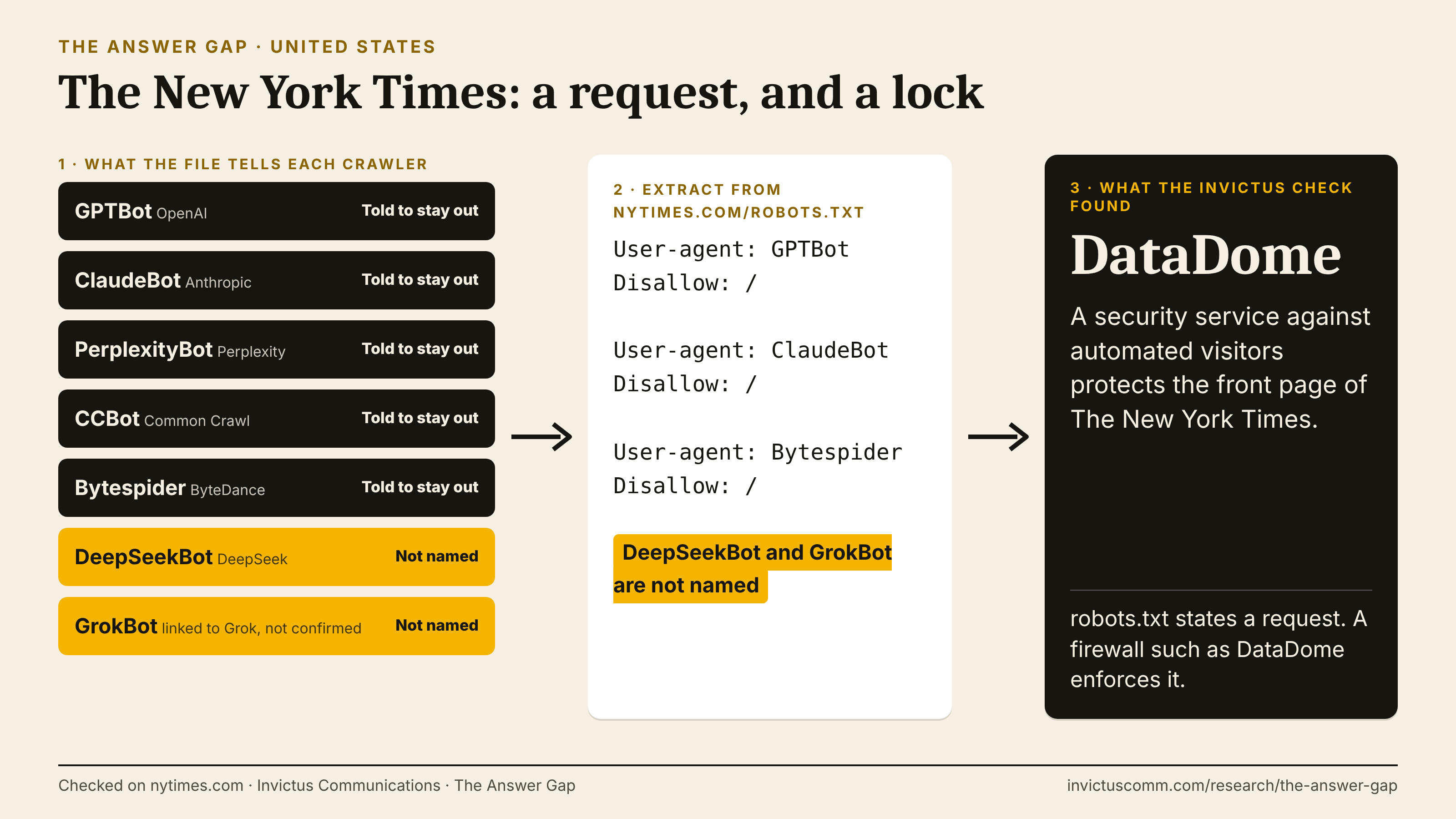
Infographic: the robots.txt file of The New York Times tells GPTBot, ClaudeBot, PerplexityBot, CCBot and Bytespider to stay out and names neither DeepSeekBot nor GrokBot. Its front page is protected by DataDome, a security service against automated visitors.
The New York Times: a request and a lockDownload image (PNG, 3200 × 1800)
Infographic: OpenAI (United States) sends GPTBot for the models behind ChatGPT; ByteDance (China) sends Bytespider; DeepSeek (China) sends DeepSeekBot; GrokBot is a name linked to Grok; SpaceX Super Intelligence has not confirmed it.
Who sends which crawler?Download image (PNG, 3200 × 1800)
Infographic: the federal order answers what agencies must do with DeepSeek products. The Answer Gap measures what U.S. government websites tell DeepSeekBot: their rules let it in on 14,659 of 15,101 websites with a clear result.
Two questions about DeepSeekDownload image (PNG, 3200 × 1800)
Infographic: three grids of the same 7,751 U.S. websites that refuse GPTBot. 9.9% allow Bytespider, 79.7% allow DeepSeekBot and 85.2% allow GrokBot.
Nearly eight in tenDownload image (PNG, 3200 × 1800)
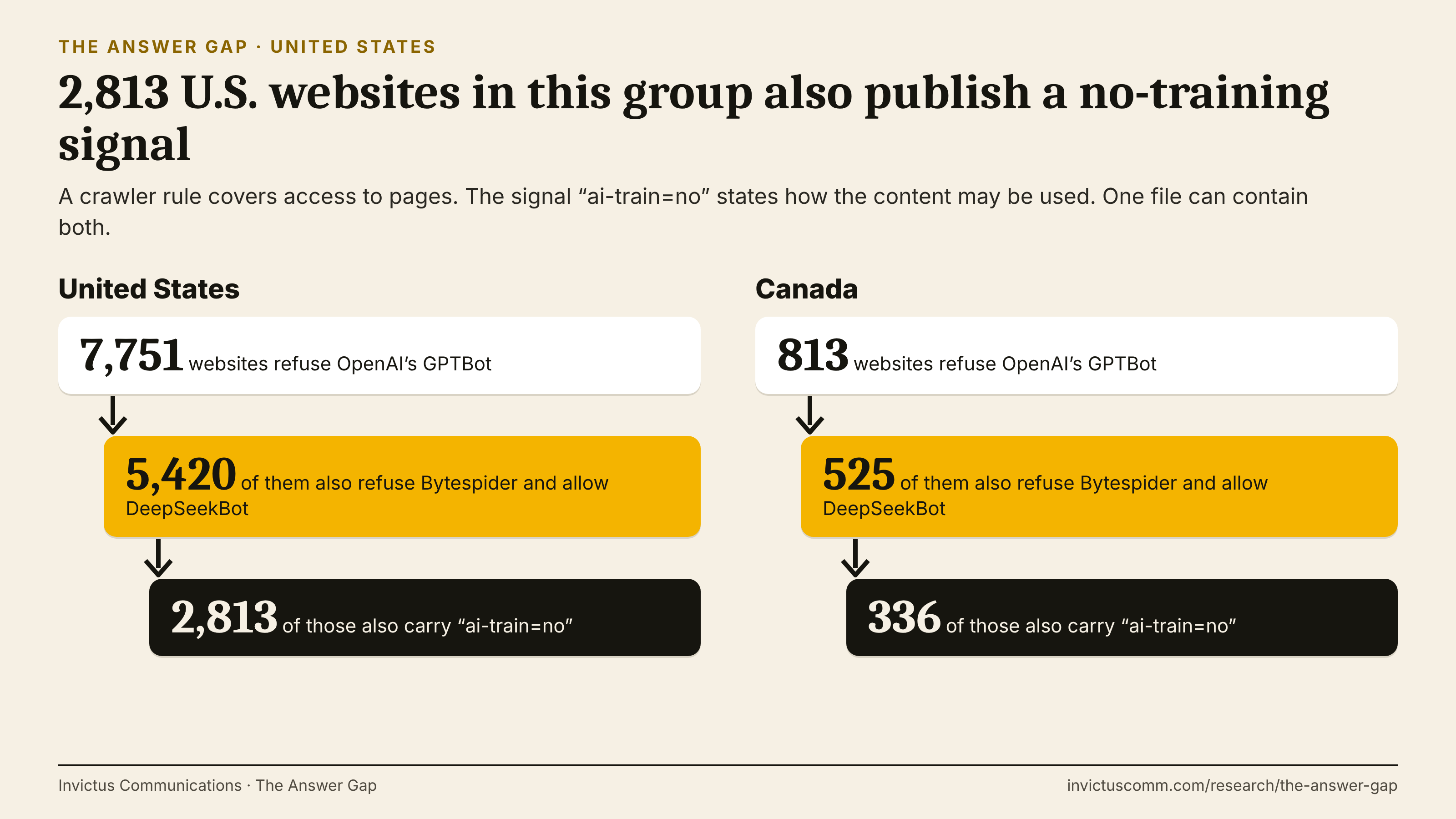
Infographic: of 7,751 U.S. websites that refuse GPTBot, 5,420 also refuse Bytespider and allow DeepSeekBot, and 2,813 of those carry “ai-train=no”. In Canada: 813, then 525, then 336.
A no-training signalDownload image (PNG, 3200 × 1800)
Infographic: type a website into the free AI-Readable Sources Index at invictuscomm.com/index/lookup.php to see what its robots.txt file tells 16 AI assistants, models and data sets. Example for nytimes.com: ChatGPT and Claude told to stay out; DeepSeek and Grok let in.
Look up any websiteDownload image (PNG, 3200 × 1800)

Cite

Invictus Communications, The Answer Gap: global edition, 24 November 2026. https://invictuscomm.com/research/the-answer-gap/