The Answer Gap
Civil Society Edition
Charity, foundation and non-governmental organisation (NGO) websites are open to AI by default. Of 224,749 civil society websites with a clear result, 84.5 per cent have no robots.txt file, or one that mentions no AI crawler by name, and 97.5 per cent let in all six crawlers that answer questions.
Request your organisation’s resultThe findingsRequest the report

When trusted organisations block AI assistants from accessing their websites, people may face life-changing decisions without the full, reliable information those organisations publish and the public deserves.
When you ask AI a question, whose information reaches you, whose voice is missing, and how does that shape what you do next?
Why civil society
Civil society organisations exist so that people can find help, rights and opportunity. People now also put their questions to AI assistants such as ChatGPT, Claude, Gemini, Grok and Perplexity. The assistants answer partly from what they can collect from websites, so what an organisation’s website tells their crawlers is one part of how it is found and described.
A robots.txt file is the public file in which a website tells crawlers, the software that collects pages for search engines and AI companies, which pages they may access. This edition reads the robots.txt files of 306,503 website addresses of charities, foundations and non-governmental organisations, and puts ten questions that people ask when they need help to ChatGPT and Grok.
The findings
Open by default. Of 224,749 civil society websites with a clear result, 84.5 per cent have no robots.txt file or one that mentions no AI crawler by name, and 97.5 per cent let in the six crawlers that OpenAI, Anthropic and Perplexity use to answer questions. Across the 240,870 websites with a clear result in the global edition, the shares are 79.9 and 91.9 per cent.
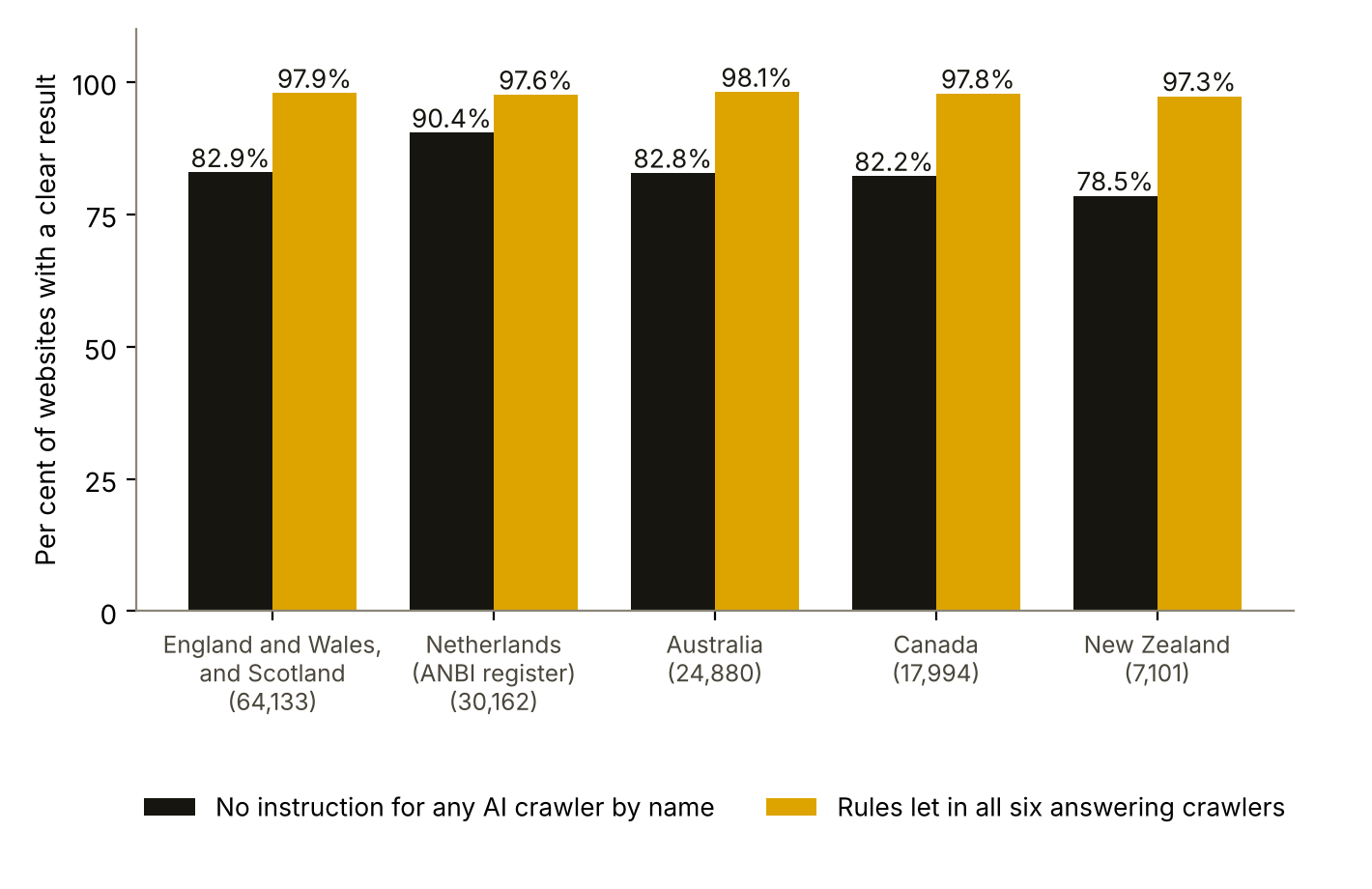
The same instructions north and south, very different counts. In Europe, the United Kingdom, North America and Oceania, 84.4 per cent of 208,223 civil society websites mention no AI crawler by name. In Africa, Latin America and the Caribbean, and South, Southeast and West Asia, the share is 84.2 per cent of 9,361. The six official charity registers that publish website addresses, the largest sources of this edition, are all in the United Kingdom, the Netherlands, Australia, Canada and New Zealand.
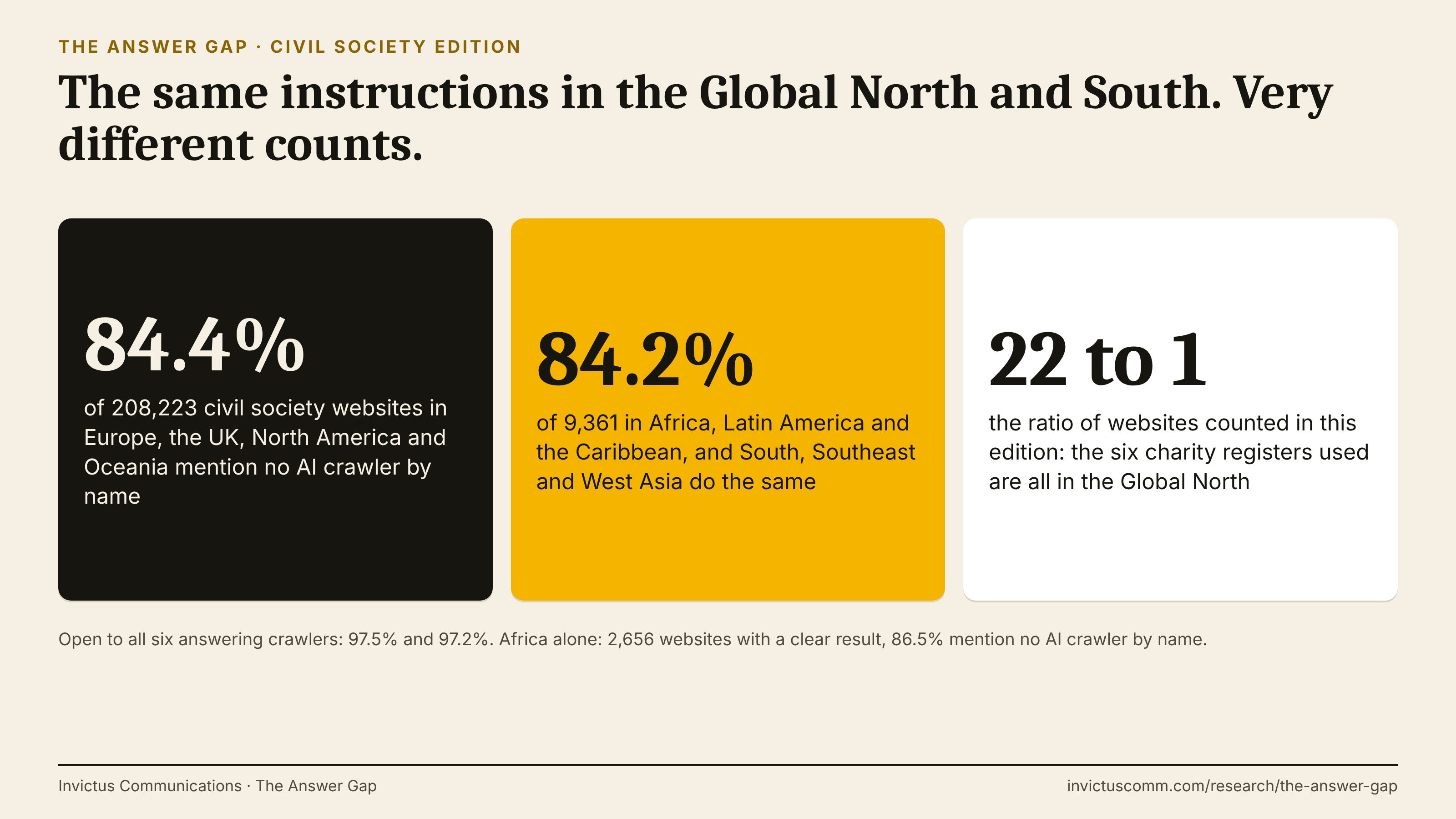
Africa. 2,656 African civil society websites gave a clear result in this edition, from Wikidata, national NGO networks, philanthropy networks and funders’ grant lists. 86.5 per cent mention no AI crawler by name, and 97.0 per cent let in all six answering crawlers.
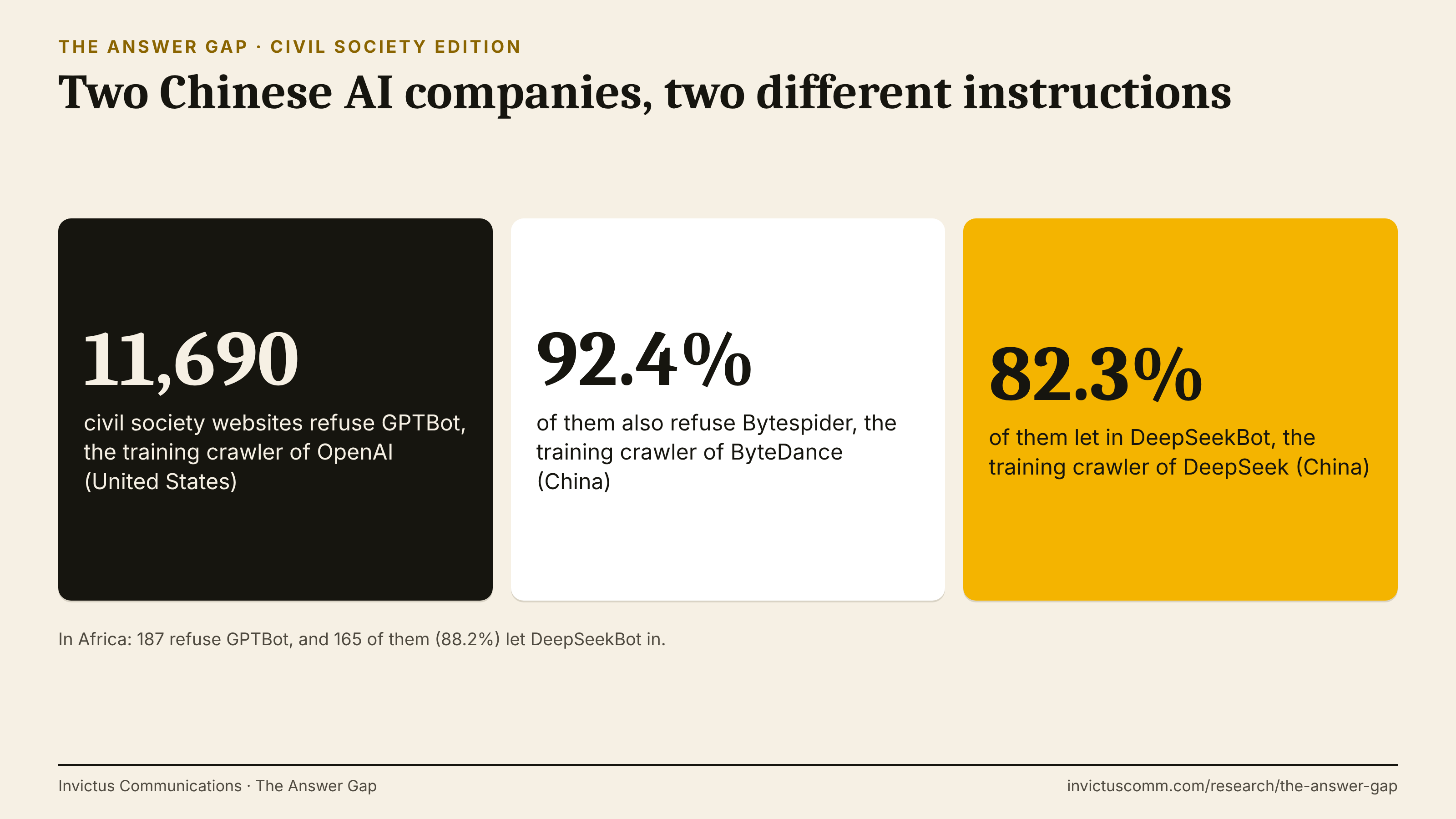
Two Chinese AI companies, two different instructions. Of 11,690 civil society websites that refuse GPTBot, OpenAI’s training crawler, 92.4 per cent also refuse ByteDance’s Bytespider, and the rules of 82.3 per cent let in DeepSeekBot, the training crawler that DeepSeek names in its own training disclosure.
The questions people ask. Asked where to find legal advice in Nairobi, food near Soweto, help after gender-based violence in Lagos, an HIV test in Lilongwe, school for a refugee child in Kampala and mental health support in Accra, ChatGPT and Grok named at least one of the same organisations in nine of the ten questions; Soweto was the exception. For Accra, Grok gave the same web address that the Ghana Ministry of Health still lists for the Mental Health Authority, which no longer leads to the authority’s website.

What organisations, funders and regulators can do
Each organisation decides what to open to AI, what to protect, and whether its content may train AI. Organisations can look up what their robots.txt file tells each crawler, keep their web address current wherever others list it, and publish basic facts about the organisation in a standard format that identifies the organisation, its website and its services. Funders can ask whether the organisations they support can be found and are described accurately. Registers and directories that publish website addresses let anyone check access at scale.
The report
The Civil Society Edition is free for journalists, researchers, regulators and civil society organisations. Request it from lindsay@invictuscomm.com. The global edition is at invictuscomm.com/research/the-answer-gap/, and the free look-up of the global Index at invictuscomm.com/index/lookup.php.
Care: in countries rated “closed” or “repressed” by the CIVICUS Monitor, civil society organisations are described and not named. A robots.txt file records what a website asks of crawlers; it does not show which crawlers visit.
Invictus Communications is a communications and research consultancy.